
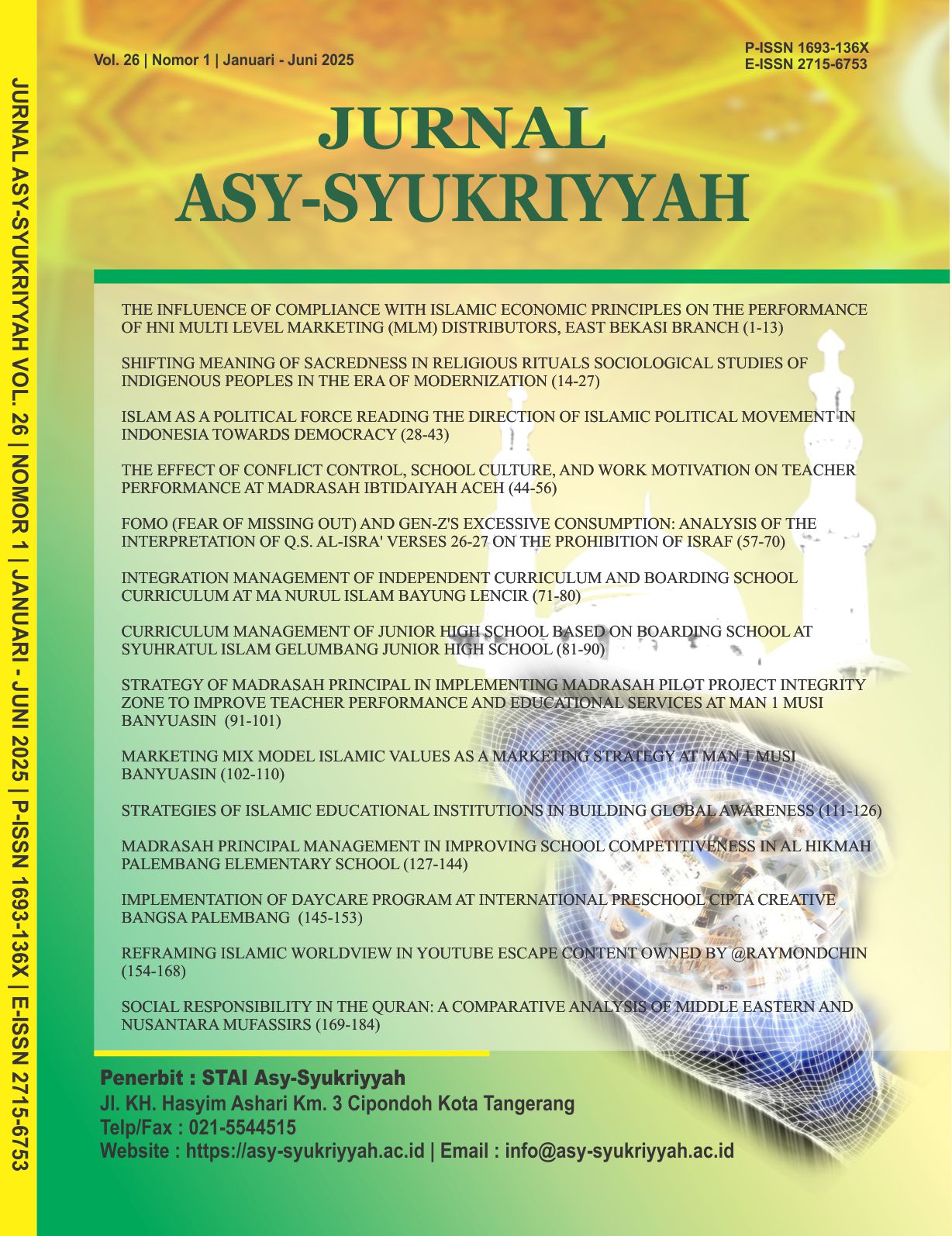
THE INFLUENCE OF COMPLIANCE WITH ISLAMIC ECONOMIC PRINCIPLES ON THE PERFORMANCE OF HNI MULTI LEVEL MARKETING (MLM) DISTRIBUTORS, EAST BEKASI BRANCH
DOI:
https://doi.org/10.36769/asy.v26i1.878Keywords:
Islamic Economic Compliance, Distributor Performance, Multi-Level MarketingAbstract
Sharia-based Multi-Level Marketing (MLM) is increasingly developing as a business alternative that aligns with Islamic economic principles. However, challenges remain in ensuring compliance with these principles and their impact on distributor performance. This study aims to analyze the influence of compliance with Islamic economic principles on the performance of distributors at HNI Bekasi Timur Branch. The Islamic economic principles examined include interest-free transactions, honesty in promotion, price transparency, contract compliance, and fairness in profit distribution. This research employs a quantitative method with a simple linear regression approach. Data were collected through questionnaires distributed to HNI Bekasi Timur Branch distributors, and their validity and reliability were tested. The results indicate that compliance with Islamic economic principles significantly affects distributor performance, with an R Square value of 0.587, meaning that 58.7% of the variation in distributor performance can be explained by the variable of compliance with Islamic economic principles. The positive regression coefficient (B = 0.745, p = 0.000) shows that the higher the compliance with Islamic economic principles, the better the distributor performance. A significant F-test (p = 0.000) also indicates that the model used is valid in explaining the relationship between the two variables. Thus, the application of Islamic economic values in business strategies has been proven to enhance the performance and competitiveness of sharia-based MLM distributors.
References
Aini, Z. N., & Susilowati, L. (2022). Tinjauan akuntansi syariah dalam penggunaan sistem informasi akuntansi multi-level marketing pada e-commerce Indonesia. JAS (Jurnal Akuntansi Syariah), 6(1), 110-126.
Akbar, F. M. A., Said, M., & Zahra, I. A. (2023). Analysis Of Sharia Aspects In The Digitalization Of Halal Tourism Business: Case Study Of Telaga Warna Wonosobo Pt. Alam Indah. International Journal Of Economics, Management, Business, And Social Science (Ijembis), 3(3), 416-29.
DEWI WAHYUNI, D. W. (2021). Sistem Multi Level Marketing Syariah Halal Network International PT. Herba Penawar Al-Wahida Indonesia Perspektif Hukum Ekonomi Syariah (Studi Kasus Pada Agen Stok Halal Mart Palopo) (Doctoral dissertation, INSTITUT AGAMA ISLAM NEGERI PALOPO).
Mufidah, A. F., & Arsyianti, L. D. (2021). Analisis Strategi Keunggulan Kompetitif Berkelanjutan Perusahaan Crowd Business Syariah (Studi Kasus pada Halal Network International). Al-Muzara'ah, 9(1), 45-69.
Permata, S., & Ikbal, M. (2021). Implementasi Etika Bisnis Pedagang Islam Dalam Transaksi Akad Bay’Al-Salam. Jurnal Asy-Syarikah: Jurnal Lembaga Keuangan, Ekonomi Dan Bisnis Islam, 3(1), 51-63.
Purkon, A. (2014). Bisnis online syariah. Gramedia Pustaka Utama.
Ruliansyah, M. D. (2019). Analisis Penerapan Sistem Syariah Dan Penjualan Produk Multi Level Marketing Syariah Dalam Peningkatan Kesejahteraan Anggota (Studi Kasus Toko Shad Network Cabang Aceh Besar) (Doctoral dissertation, UIN Ar-Raniry Banda Aceh).
Wafiroh, N. M. (2020). Pengaruh Kualitas Pelayanan, Promosi Model Multilevel Marketing Dan Kepercayaan Terhadap Loyalitas Konsumen Pada Konsultan Pt. Orindo Alam Ayu (Oriflame) Di Ponorogo (Doctoral dissertation, IAIN Ponorogo).
Winengsih, E. (2018). Aplikasi penggunaan akad pada PT Veritra Sentosa Internasional (Bachelor's thesis, Jakarta: Fakultas Syariah Dan Hukum UIN Syarif Hidayatullah).
Downloads
Published
How to Cite
Issue
Section
License
Copyright (c) 2025 Sofwan Jauhari

This work is licensed under a Creative Commons Attribution-ShareAlike 4.0 International License.