
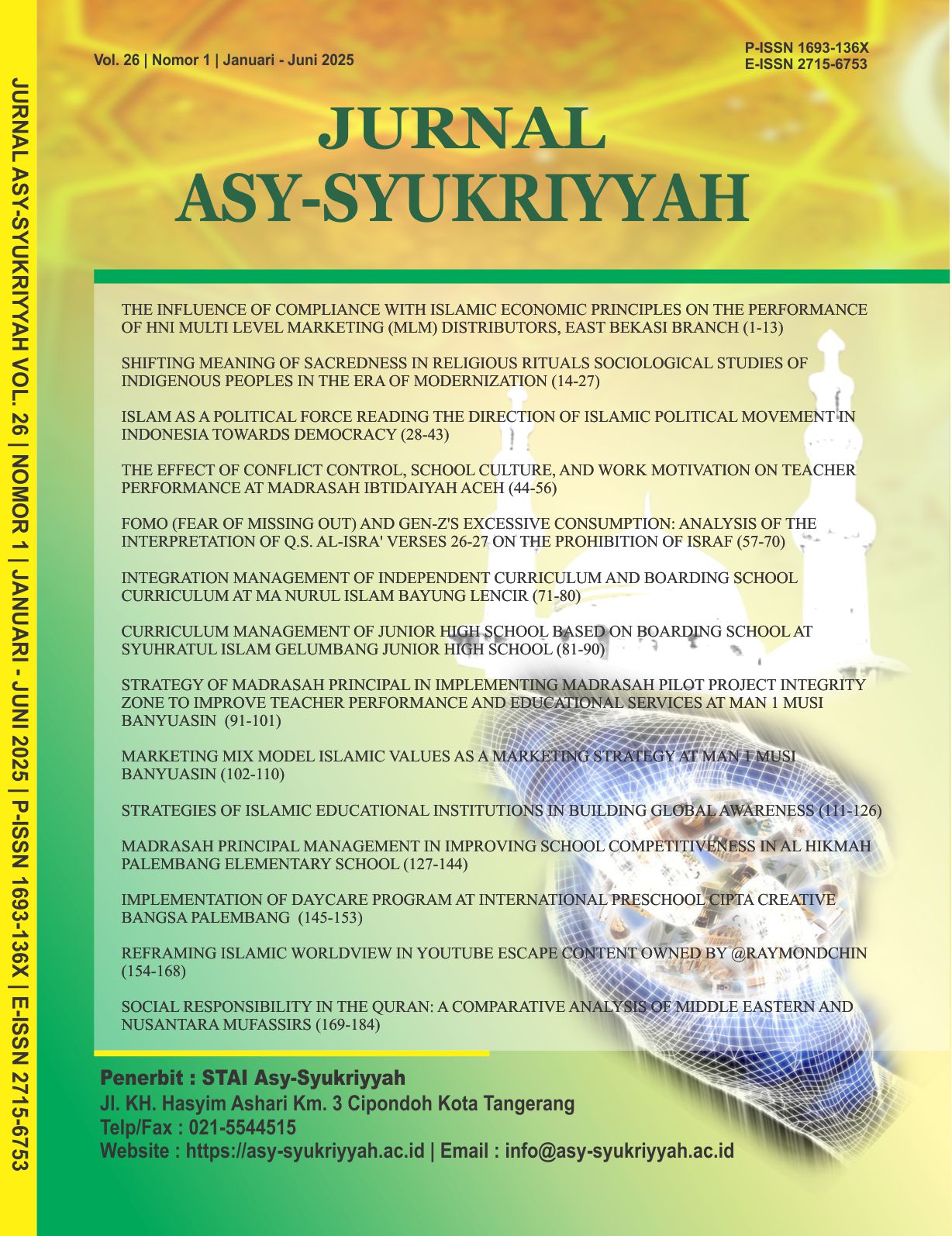
FOMO (FEAR OF MISSING OUT) AND GEN-Z'S EXCESSIVE CONSUMPTION: ANALYSIS OF THE INTERPRETATION OF Q.S. AL-ISRA' VERSES 26-27 ON THE PROHIBITION OF ISRAF
DOI:
https://doi.org/10.36769/asy.v26i1.934Keywords:
FOMO, Excessive consumption, Gen-Z, Interpretation of Q.S. Al-Isra’, Israf prohibitionAbstract
The Fear of Missing Out (FOMO) phenomenon has become a prominent issue among college students, especially in the context of a consumerist lifestyle influenced by social media. College students often feel pressured to follow consumption trends such as using branded goods, visiting popular places, and attending big events, even though they are expensive and sometimes lead to israf (wasteful) behavior. This article aims to analyze the FOMO phenomenon and excessive consumption from the perspective of the interpretation of QS. Al-Isra’ verses 26–27, which emphasize the prohibition of waste and the importance of managing resources wisely. The research approach used is qualitative with literature studies and secondary data from various sources, including social media observations. The results of the analysis show that the FOMO phenomenon can be associated with the influence of social media that encourages college students to consume excessively, which is contrary to Islamic teachings on simplicity and managing sustenance. Education based on Islamic values, such as qana’ah and sharia financial literacy, is the key to overcoming this problem. This study suggests the importance of an educational approach to introduce an Islamic consumer lifestyle among students, so that they can be wiser in using resources and avoiding waste.
References
Alfian, Ian. “ Fomo Dan Media Sosial: Dampak Perilaku Konsumtif Terhadap Kesehatan Mental Dan Keuangan Dari Perspektif Islam. ” PROFJES: Profetik Jurnal Ekonomi Syariah 3, no. 2 (November 14, 2024). https://doi.org/10.24952/profjes.v3i2.13119.
Ash-Shiddieqy, Teungku Muhammad Hasbi. Tafsir Al-Quranul Majid An-Nur Jilid 2. Cakrawala Publishing, n.d.
Barker, Eric. “ This Is The Best Way to Overcome Fear of Missing Out. ” TIME, June 7, 2016. https://time.com/4358140/overcome-fomo/.
Chakrabarti, Debangana. “ A Study on How Social Media FOMO (Fear of Missing Out) Impacts the Gen Z Audience. ” Indian Journal of Mass Communication and Journalism 4, no. 1 (September 30, 2024): 1-y. https://doi.org/10.54105/ijmcj.E1083.04010924.
Eriyanto. Analisis Isi: Pengantar Metodologi untuk Penelitian Ilmu Komunikasi dan Ilmu-ilmu Sosial Lainnya . Prenada Media, 2015.
Fahriansah, Fahriansah, Nanda Safarida, and Shelly Midesia. “ Buy Now, Think Later: Impulsive Buying Behavior Among Generation Z In Indonesia. ” Share: Jurnal Ekonomi Dan Keuangan Islam 12, no. 2 (October 7, 2023): 386–421. https://doi.org/10.22373/share.v12i2.17453.
Fitria, Novy, Fathonah Hadromi, and Een Yualika Ekmarinda. “ FOMO and Its Effect on Gen Z Performance, ” 142–46. Atlantis Press, 2024. https://doi.org/10.2991/978-94-6463-346-7_27.
“FOMO Handbook. ” Accessed May 4, 2025. https://patrickmcginnis.com/wp-content/uploads/2023/02/FOMO-Handbook.pdf.
“Hypocritical Gen Z Can’t Stop Buying This Planet-Destroying Product. ” Accessed May 4, 2025. https://nypost.com/2024/10/02/lifestyle/hypocritical-gen-z-cant-stop-buying-this-planet-destroying-product/.
“Indonesia Gen-Z- Report 2024. ” Accessed May 4, 2025. https://cdn.idntimes.com/content-documents/indonesia-gen-z-report-2024.pdf.
Khairanis, Retisfa, and Muhammad Aldi. “ Peran Tafsir Bil-Ma’tsur Dalam Pembentukan Identitas Muslim Kontemporer Di Era Globalisasi. ” Iqro Bhisma (IB) : Jurnal Studi Ilmu Keagamaan Islam 1, no. 1 (March 11, 2025): 19–28.
MA, Dr Iqrom Faldiansyah. Dakwah Virtual di Media Sosial Perspektif Al-Qur’an. Publica Indonesia Utama, 2023.
Maguire, Lucy. “ Gen Z Loves Shopping Hauls. Can They Ever Be Sustainable? ” Vogue Business, August 29, 2022. https://www.voguebusiness.com/fashion/gen-z-loves-shopping-hauls-can-they-ever-be-sustainable.
Maulidin, Syarif. “ Pemanfaatan Media Sosial Sebagai Sarana Dakwah Dan Pendidikan Pada Pelajar. ” Journal Khafi : Journal Of Islamic Studies 3, no. 1 (2024): 27–39.
Muttaqin, Zein. “ Islamic Consumer Ethics: A View on Israf Behavior. ” Accessed May 4, 2025. https://www.academia.edu/19759133/ISLAMIC_CONSUMER_ETHICS_A_View_on_Israf_Behavior.
———. “ The Nature of Excessive Behavior (ISRAF) in the Islamic Economic Framework. ” GATR Journal of Business and Economics Review 4, no. 1 (March 30, 2019): 49–57. https://doi.org/10.35609/jber.2019.4.1(6).
Parawansah, Siti Hanifah, and Ainur Rofiq Sofa. “ Pendekatan Komprehensif Berbasis Al-Qur’an Dan Hadits Dalam Pengembangan Pendidikan Islam: Integrasi Nilai, Metode, Evaluasi, Sosio-Kultural, Dan Kompetensi Pendidik. ” Karakter : Jurnal Riset Ilmu Pendidikan Islam 2, no. 1 (2025): 187–205. https://doi.org/10.61132/karakter.v2i1.407.
Przybylski, Andrew K., Kou Murayama, Cody R. DeHaan, and Valerie Gladwell. “ Motivational, Emotional, and Behavioral Correlates of Fear of Missing Out. ” Computers in Human Behavior 29, no. 4 (July 1, 2013): 1841–48. https://doi.org/10.1016/j.chb.2013.02.014.
“Qur’an Kemenag. ” Accessed May 4, 2025. https://quran.kemenag.go.id/quran/per-ayat/surah/17?from=1&to=111.
Quthb, Sayyid. Tafsir Fi Zhhilalil-Qur’an Di Bawah Naungan Al-Qur’an Jilid 7. Jakarta: Gema Insani Press, 2003.
Rohmah, Firda Tazqiyatu, Firda Silviahana, Amanda Titasyfa, Zaini Ibrahim, and Wahyu Hidayat. “ Pengaruh Gaya Hidup Dan Perilaku Konsumtif Belanja Online Pada Remaja. ” Jurnal Intelek Insan Cendikia 1, no. 4 (June 28, 2024): 1199–1210.
Rukin. Metodologi Penelitian Kualitatif. Takalar: Yayasan Ahmar Cendekia Indonesia, n.d.
Shidiqie, Ni’amulloh Ash, Nouval Fitra Akbar, and Andhita Risko Faristiana. “Perubahan Sosial Dan Pengaruh Media Sosial Tentang Peran Instagram Dalam Membentuk Identitas Diri Remaja.” Simpati 1, no. 3 (June 11, 2023): 98–112. https://doi.org/10.59024/simpati.v1i3.225.
Shihab, Muhammad Quraish. Tafsir Al-Misbah : Pesan, Kesan, Dan Keserasian Al-Qur’an. 3rd ed. Vol. 7. Jakarta: Lentera Hati, 2005. https://dn720209.ca.archive.org/0/items/etaoin/Tafsir%20Al-Mishbah%20Jilid%2007%20-Dr.%20M.%20Quraish%20Shihab.pdf.
Subandi. Metode Penelitian: Sebuah Pengantar Ringan untuk Melakukan Penelitian. Goresan Pena, 2025.
Suryaningrum, Dyah Ayu, Eva Yuniarti Utami, Hayu Lusianawati, and Najdah Thalib. “ Analysis of Generation Z Consumer Behavior in the Food and Beverage Industry in Indonesia: The Influence of Product Personalization, Social Media Engagement, and Brand Experience. ” West Science Journal Economic and Entrepreneurship 1, no. 07 (July 30, 2023): 300–308. https://doi.org/10.58812/wsjee.v1i07.461.
Susilowati, Eni, Yhadi Firdiansyah, and Ayu Febri Puspitasari. “ Menerapkan Etika Konsumsi Islami Di Era E-Commerce. ” El-Kahfi | Journal of Islamic Economics 5, no. 02 (September 30, 2024): 396–406. https://doi.org/10.58958/elkahfi.v5i02.353.
Yulianti, and Tatik Maryati. “ Consumption Behavior In Islam. ” Indonesian Journal of Business, Accounting and Management 6, no. 2 (2024): 67–80. https://doi.org/10.36406/ijbam.v6i02.865.
Downloads
Published
How to Cite
Issue
Section
License
Copyright (c) 2025 Evan Hamzah Muchtar

This work is licensed under a Creative Commons Attribution-ShareAlike 4.0 International License.